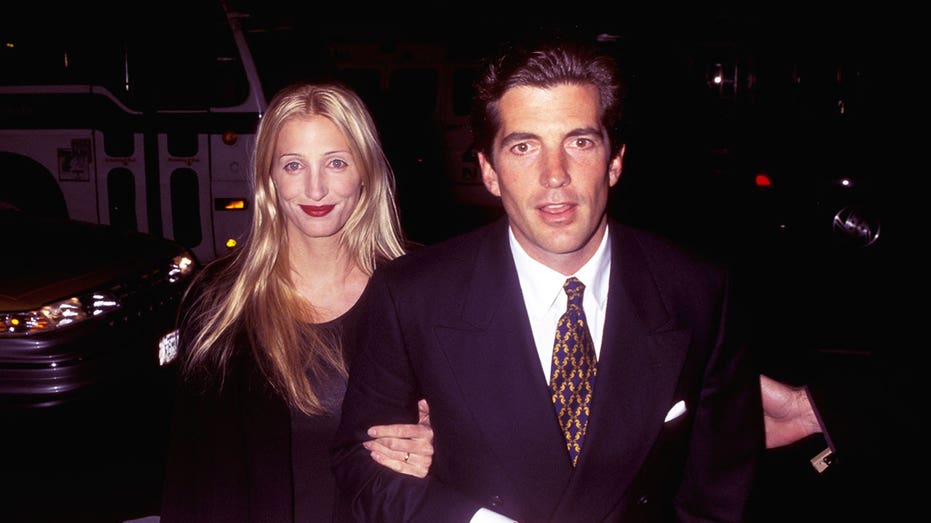
Kyle Bailey felt a “deep concern” as he watched John F. Kennedy Jr., Carolyn Bessette Kennedy and Lauren Bessette climb aboard the small plane that would never reach its destination.
On July 16, 1999, the trio perished when the single-engine plane Kennedy was piloting crashed into the Atlantic Ocean near Martha’s Vineyard. At the time, Bailey had also planned to fly to the island off the coast of Massachusetts but changed his mind because of “iffy” weather conditions.
Bailey, a licensed pilot and aviation analyst for Fox News — and the last known person to see Kennedy his wife and sister-in-law alive — has written a new book, “Witness: JFK Jr.’s Fatal Flight.” It examines the circumstances that led to the tragedy.
CREATORS OF JFK JR TV SERIES RESPOND TO KENNEDY HEIR DENOUNCING SHOW AS ‘GROTESQUE’
“I’ve seen John do that trip many, many times,” the 52-year-old told Fox News Digital. “It was just a typical Friday night. I planned on making two flights, an earlier flight in the afternoon, which I did for about an hour, just to go up for a spin. And then the nighttime flight was longer. It was, as we say in aviation, the three H’s — hazy, hot and humid. Your typical New York City July day and evening.”
“From my experience, I sensed that, based on those conditions, there probably would be reduced visibility that night up in Martha’s Vineyard,” Bailey said. “It didn’t mean I was going to cancel my trip right then, though.”
Bailey, then 25, was at Essex County Airport in Caldwell, New Jersey, when Kennedy arrived in an unassuming vehicle. At one point, the magazine publisher even whizzed by Bailey to buy a bottle of water and a banana from the convenience store. Everything appeared ordinary, said Bailey.
WATCH: AVIATION EXPERT EXPLAINS JFK JR.’S FINAL FLIGHT RISKS
When Bailey embarked on his first short trip, he noticed that visibility “wasn’t great.” After landing, he monitored the weather. But as temperatures rose, it became hazier, raising concerns that fog could quickly develop along the coast.
Bailey decided to call off his trip.
“I decided that night to cancel the flight,” he said. “I was mad, but it was the right decision for me.”
Still, Bailey continued to keep a close eye on the conditions.
“I was noticing that the temperature and dew point, those spreads were getting closer and closer,” he explained. “In weather, what that means is, there’s a very high probability of ground fog developing. In John’s case, perhaps he wasn’t told that or didn’t know. You really can’t fault him for that, for what he doesn’t know or what he wasn’t told.”
“I knew from experience on those very hot, hazy, humid summer nights, fog and low visibility could be a problem, especially flying over water,” he shared.
CLICK HERE TO SIGN UP FOR THE ENTERTAINMENT NEWSLETTER
“In John’s case, especially at nighttime, he was planning on leaving after I was going to. It would’ve been more challenging for a VFR pilot with hazy, hot, humid conditions, a partial horizon, and now, on top of that, total darkness.”
“For a VFR pilot at night, when you lose that horizon, it’s like jumping off the edge of the earth into a complete sea of darkness,” he added.
After Kennedy quietly completed his pre-flight checks, Bailey saw his plane take off at 8:38 p.m.
“I went home to my mother that night and said something to the effect of, ‘I just saw JFK Jr. at the airport. I hope he doesn’t kill himself someday in that airplane,’” Bailey recalled.
“That Piper Saratoga was a new airplane for him. It was complex and high-performance, unlike his older airplane, which he had just sold. I really hoped he had his instructor with him. I was just concerned for him. Was it a premonition? Possibly. But it was more of a deep concern for John and the two others.”
Kennedy had purchased the plane in April 1999, months before the crash. According to reports, he had logged only a few dozen hours in the Saratoga with limited night experience in the aircraft.
LIKE WHAT YOU’RE READING? CLICK HERE FOR MORE ENTERTAINMENT NEWS
“I wasn’t sure if he had an instructor aboard the airplane,” said Bailey. “After the tragedy, a lot of people would come up to me and say, ‘Why did you let him take off? Why didn’t you say something?’ The answer is, I didn’t know who was on the plane with them.
“I saw the three of them board the plane, but since I wasn’t fixed on that plane the entire time, I wasn’t sure if an instructor walked over there. That’s why I didn’t say anything. I just hoped he had an instructor with him. The conditions weren’t horrible, but they weren’t great.”
Bailey didn’t know that earlier in the day, Kennedy had told his flight instructor he didn’t need him for the journey and that he “wanted to do it alone.”
The plan seemed simple. Kennedy would first fly to Martha’s Vineyard and drop off his sister-in-law. Then he and his wife would head to Hyannis Port for the wedding of his cousin, Rory Kennedy, the next day.
But at the time, Kennedy was still in the process of completing his instrument training and was flying by visual flight rules. While he had about 300 hours of flying experience, he was recovering from a broken ankle. It was also a dark, moonless night.
Under those conditions, investigators believe Kennedy may have struggled to see shore lights or other landmarks to help guide him.
Bailey said the “graveyard spiral” quickly came to mind.
“It’s a rapid turning descent of the airplane,” he said. “In John’s case, it would be from losing that visual horizon. Your mind is playing tricks with you, saying you’re straight, you’re turning, but you really aren’t.”
“Imagine you have the control column in front of you,” Bailey explained. “You pull back, the plane goes up. You push forward, and that goes down. You turn the control right or left, and you know the plane will turn. But if you’re a novice pilot or if your mind is playing tricks on you, your first instinct is to pull that control column back. But being that the airplane is in a turn and the wings aren’t level, it’s actually tightening that spiral and increasing the G-forces.
“If you put enough G-force on the airplane, you could overstress the components, like the wing and tail. You could have structural failure. But in John’s case, the result was crashing into the ocean, unfortunately.”
On Saturday morning, Bailey checked the weather at an FAA flight service station. He wondered if he could fly that day instead. But a missing-airplane alert was issued — a Piper Saratoga that had departed Essex County Airport that Friday evening.
Bailey’s heart sank.
“I immediately recognized the color of the Saratoga and the tail number,” he said. “I was hoping, praying that maybe he turned back or was in Martha’s Vineyard on the ground.
DARYL HANNAH GETS ‘DIRTY’ TREATMENT IN NEW JFK JR. SERIES AS FANS CRY FOUL OVER PORTRAYAL
“I remember I told my family, ‘If this airplane is not found within two hours, he is probably a goner, along with the other two on the plane. I assumed the worst, but hoped for the best that there was maybe even a slim chance somebody might be found alive. But in the back of my mind, I knew that was pretty much not going to happen.”
The wreckage of the Piper Saratoga was found five days later. Navy divers recovered the bodies of Kennedy, 38, Bessette Kennedy, 33 and Bessette, 34, from the ocean floor.
“The National Transportation Safety Board determines the probable cause(s) of the accident to be: the pilot’s failure to maintain control of the airplane during a descent over water at night, which was a result of spatial disorientation,” the report read. “Factors in the accident were haze and the dark night.”